




DANVILLE, Ind. On May 10, 1878, the people of Danville sent vehicles over to Ladoga, in Montgomery County, and hauled home a college along with its teachers, students and school apparatus, according to a 1914 history of Hendricks County.
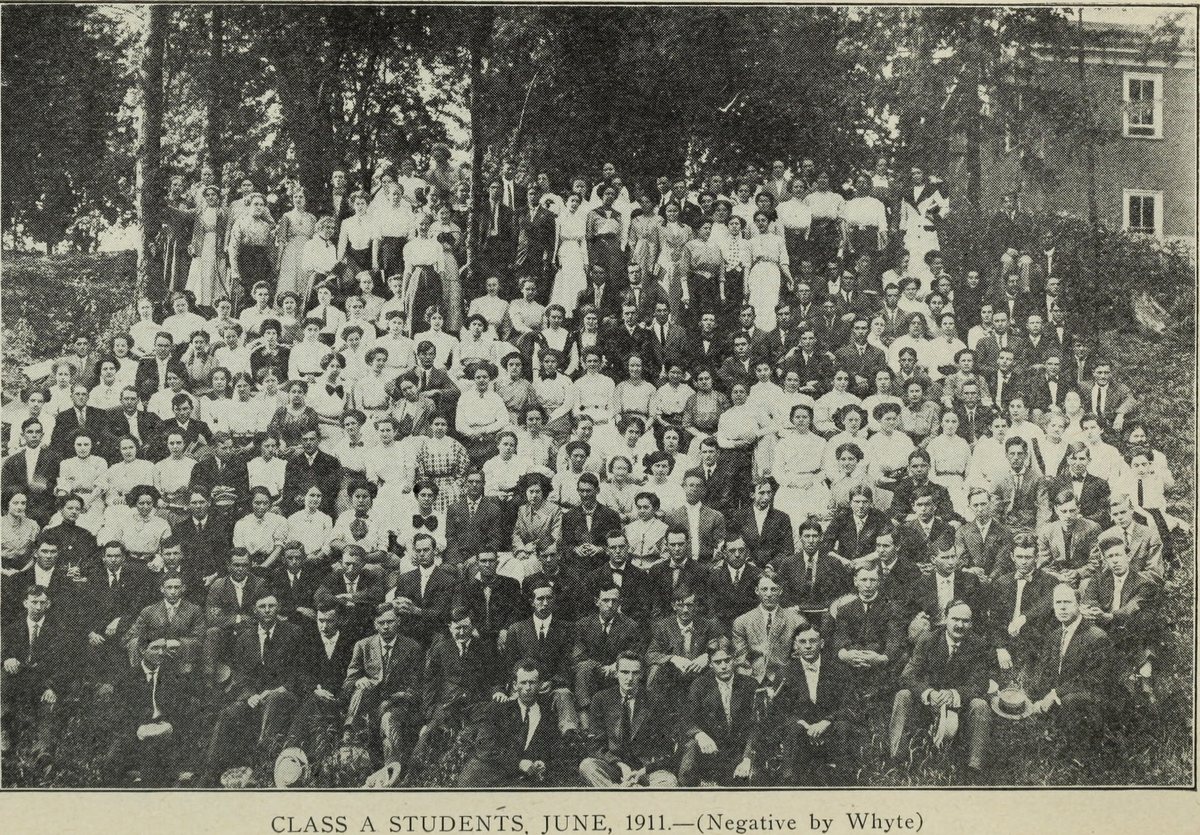
For the next 73 years the county seat was a college town, until the last of it closed in 1951, 75 years ago this year. In those years a future governor sat in the classrooms, students in 1911 could take their meals at boarding clubs in family homes for $1.50 a week, and that year's catalog told of a Reunion that nearly always filled a hall seating a thousand.
The day the college came to town
Central Normal College was organized in 1876 at Ladoga as the second private normal school in Indiana that specialized in training teachers, and it was modeled on the methods Alfred Holbrook used at his normal college in Lebanon, Ohio, according to the Indiana Historical Bureau marker placed at Main and Wayne streets in 2001. The founders, W.F. Harper and J.W. Darst, enrolled 48 students in their first term, and by the second year so many had come that the school needed more room, John V. Hadley's "History of Hendricks County, Indiana" recounts.
Many people gave cash toward a larger schoolhouse in Ladoga, but others refused to help, and "this lost the school to Ladoga," the 1914 history says. The vehicles Danville supplied hauled the teachers, "their hundred and seventy-five students" and their belongings over to the new home, and the book sums up the trip this way: "The procession through the country and the reception given in Danville were events of great importance."
The Hendricks County Historical Museum tells the trip a little differently, describing a caravan of wagons and buggies and saying the male students traveled with it while the female students took a train to Greencastle and then on to Danville. Both accounts agree that Danville families opened their homes to the newcomers, and the 1914 history says school was not interrupted, with classes picking up in the old seminary building that had been the home of the Methodist Academy. The citizens of Danville then bought the building by popular subscription, the history says.
A college that paid its own way
Frank P. Adams, who came from Kentucky to help Harper and became the college's president and owner, died Nov. 25, 1882, at age 30, according to Hadley's history. Before his death he asked his wife, Ora Adams, to take the presidency, and she held it until after her marriage to James A. Joseph on July 10, 1889, the history says.
Under the presidents who followed, another large building, Chapel Hall, went up just across the street west of the original, and the spring term of 1891 enrolled 771 students, according to the history. In August 1900 a stock company of 80 Danville citizens bought the college, and in 1911 the stockholders donated their stock so that a board of trustees serving without pay could run it, the history says.
"It has never had any help to pay operating expenses," Hadley's book says of the college. "It has been entirely independent of church, state or endowment." By then its former students held a row of state offices, among them S.M. Ralston, who was Indiana's governor when the history went to press.
Room, board and the Reunion
The college's own Quarterly for September 1911, which served as its annual catalog, shows what a term in Danville cost and what a student's room held, down to the coal bucket. Tuition was $15 for 12 weeks, table board was $1.50 a week at boarding clubs kept "in the homes of private families, not in dormitories," and a room ran 50 to 75 cents a week for each student, two to a room, furnished with "a carpet, stove, coal bucket or wood box, bed, bedding, chairs, study table, washstand, bowl, pitcher, mirror, etc." A student who paid in advance could have tuition, board and one of the 50-cent rooms for a full school year of 48 weeks for $145.
New arrivals were told to "try to arrive on a day train and come at once to the College office," leaving their trunks at the station until they had picked a room. Danville sat on the Big Four railroad and on the Terre Haute, Indianapolis and Eastern electric line, whose cars, the catalog said, "leave Indianapolis almost every hour of the day and evening."
General Exercises were held at 8:30 every morning, with attendance "altogether voluntary," the catalog said, and the evenings brought what it called "our bi-weekly Reunion," described there as "the social event of our town and school" and held in an assembly room that seated a thousand and was "nearly always filled." Once the program was over, the catalog said, "Conversation and promenading are among the leading features."
The same catalog, under the heading "Colored Students," states the college's admission practice in a single sentence: "From the first it has been, and now is, the custom of the College not to admit colored students."
The last classes
More than 75,000 people attended the college over the years, and it served mainly to train teachers, according to the Hendricks County Historical Museum. After World War II the GI Bill let students choose larger colleges and enrollment dwindled, the museum says.
Central Normal, by then the "last self-supporting private normal school in Midwest," closed in 1946, the state marker says. The Episcopal Church reopened the school as Canterbury College, and a "declining financial situation forced closure 1951."
What is still there
The campus eventually had five buildings, and when the marker went up in 2001, Hargrave Hall, the gymnasium and the well house remained as part of Danville Middle School, according to the marker's text. Today the Danville police station sits on the site and uses Hargrave Hall, according to the Danville Public Library, and the town's own map of Town Hall at 49 N. Wayne St. shows the police department on floors it labels Hargrave. In its Indiana Room the library keeps the college's catalogs, histories, newspapers, photographs, postcards and yearbooks.
The museum and the library are having the college materials held at both places digitized through a grant from the Indiana State Library, and many of the records can already be read online, the museum says. The museum, which keeps a large collection of the college's yearbooks, pictures and grade books, is still missing the yearbooks for 1917 to 1928, 1930, 1932 to 1934, 1945, 1946 and 1951 to 1954, and it asks anyone who has one to get in touch, even if they would rather lend the book for copying and keep it.
Hadley's history counted 175 students in the school that left Ladoga on that Friday in May for want of a larger schoolhouse, and Danville made room for them in its homes and in an old seminary building, and kept making room for 73 years. Nearly a century and a half later Hargrave Hall still stands on the old campus, and the museum is still waiting on the yearbooks that have not yet come home, the missing pages of a college that Danville once sent wagons to Ladoga to bring back.
Label: Reported by us.
Corrections
No corrections to this story. If something here is wrong, tell us. Every correction is dated on the story and listed in our public log.
Sources (7)
- "Central Normal College," Indiana state historical marker 32.2001.2, Indiana Historical Bureau, installed 2001
- "History of Hendricks County, Indiana, her people, industries and institutions," John V. Hadley, editor, B. F. Bowen and Co., Indianapolis, 1914, pages 164 to 166, Library of Congress copy via Internet Archive
- Central Normal College Quarterly, Vol. 11, No. 2, September 1911 (the college's annual catalog), University of Illinois Urbana-Champaign copy via Internet Archive
- "Central Normal College," Hendricks County Historical Museum
- "Indiana Room," Central Normal College Collection, Danville Public Library
- Danville Town Hall map, 49 N. Wayne St., Town of Danville, 2024
- Photo: "Class A Students, June, 1911," negative by Whyte, from the Central Normal College Quarterly, September 1911, marked "No known copyright restrictions" on Wikimedia Commons (https://commons.wikimedia.org/wiki/File:Annual_catalogue_(1910)_(14801856853).jpg)